
Our cases

Clients about us
EdTech Software Development
Custom EdTech Software Development for Educational Institutions

Our EdTech and eLearning development team create tailor-made distance learning solutions for educational institutions. A unique approach, non-standard solutions, and attractive design will distinguish your product from competitors.
We carefully study your approach to provide a unique custom EdTech software development that conveys your uniqueness, experience, and expertise. Building an EdTech mobile app? Our mobile app development services cover iOS and Android delivery for eLearning products, including Flutter and React Native options. For a commercial multi-tenant product that is not an LMS, see digital platform development services. Adaptive paths, recommendations, and other AI features are scoped through our AI development services practice — not as a slide-on chatbot. Workforce HRIS, payroll, and ATS products are HR software development services, not this LMS page — talent development here means course delivery, not an employee system of record. When your product lead already owns the backlog and you need extra engineers in that sprint, the seat model is staff augmentation services.
Why Generic LMS Fails Growing EdTech Businesses
Off-the-shelf platforms look affordable until your business starts scaling.
Vendor Lock-In Strangles Growth
When the roadmap belongs to the vendor, every feature request becomes a year-long negotiation. Teams build workarounds, technical debt compounds, and migration costs become prohibitive — all while competitors ship faster on custom platforms.
Per-User Costs Explode at Scale
SaaS LMS pricing looks reasonable at 500 learners. At 50,000 it becomes your biggest IT line item. Custom-built platforms convert variable per-seat cost to fixed infrastructure, eliminating the penalty for growing your learner base.
Rigid UX Kills Engagement
Generic platforms enforce their own design patterns. Your brand disappears behind someone else's UI, and you cannot adapt the learning flow to your pedagogy — forcing learners into an experience built for the average user, not your audience.
Integration Debt Accumulates Silently
Connecting an off-the-shelf LMS to your CRM, HR system, payment gateway, and analytics stack almost always requires custom middleware. You end up paying for development anyway — while living with a platform you cannot fully control.
Success Stories
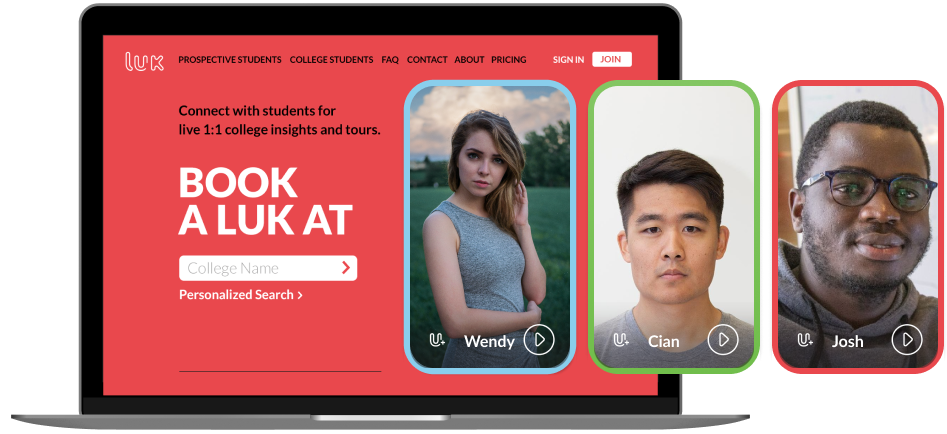
Connect with students for live 1-on-1 college insights and tours
EXPERTISE
Education
TECHNOLOGIES

Education Software Development Services

BUILD AN ELEARNING PLATFORM WITH UNIQUE FEATURES TO CREATE A COMPETITIVE ADVANTAGE
Depending on your direction, add unique eLearning software development services: course delivery, branding, eCommerce, and more. Packaged courses run through SCORM so progress and completion sync with the LMS. Detailed learner activity streams use xAPI (Tin Can) for experience tracking beyond simple SCOs. Tool launch and services follow LTI 1.3 / LTI Advantage so external apps embed securely in the LMS.

PERSONALIZED LEARNING TO ENGAGE LEARNERS AT EVERY STAGE OF LEARNING
Streamline your learning experience, create almost any interaction you can imagine, save students time, track their progress, and generate reports on their performance. Assessment items exchange through QTI so quizzes move between authoring tools and delivery engines. Roster and grade sync use OneRoster with SIS and LMS partners. Portable course packages ship as Common Cartridge for cross-platform content reuse.

ENGAGE CUSTOMERS WITH A VISUALLY COMPELLING PLATFORM
Let UX design become a competitive advantage that attracts new customers by making learning enjoyable and easy on your fully customizable and intuitive platform. Interfaces target WCAG 2.2 AA so keyboard, contrast, and assistive-tech paths work for all learners. Federal and contractor buyers get Section 508 aligned ICT accessibility checks. Procurement packages include a VPAT so buyers can review accessibility conformance evidence.
From Brief to Launched Platform: Our EdTech Development Process
A clear engagement model so you always know what happens next.
Discovery & Scoping
We map your learner journeys, technical constraints, and business goals into a concrete product scope — with timeline and cost estimate before a single line of code is written.
Architecture & UX Design
Solution architects define the tech stack, integration points, and data model. UX designers produce interactive prototypes you validate with real users before development begins.
Agile Development
Two-week sprints with working demos. You see progress every iteration, catch course corrections early, and maintain full visibility via your own project dashboard.
QA & Compliance Testing
Each release goes through functional, performance, and accessibility testing. SCORM, xAPI, and LTI compliance is validated before delivery — not patched in afterward.
Launch & Ongoing Support
We handle deployment, data migration, and team onboarding. Post-launch support retainers keep your platform evolving as your learner base and curriculum grow.
Custom EdTech Software vs Off-the-Shelf LMS
The decision every EdTech founder faces. Here is the honest comparison.
- Advantage
- Limitation or compromise
- Criterion not met
EdTech Software Development Cost
Transparent ranges to help you scope the conversation — not fixed quotes.
MVP
$30k – $80k
3–4 months
- LMS / LXP core module
- SCORM / xAPI compliance
- User auth & role management
- Basic learner analytics
- Up to 2 third-party integrations
Growth
$80k – $150k
5–8 months
- Everything in MVP
- Custom content authoring tools
- Advanced analytics & reporting
- Mobile-optimised learner app
- Up to 5 integrations + SSO
Enterprise
Custom Quote
6+ months
- Everything in Growth
- Multi-tenant / white-label architecture
- AI-driven learning recommendations
- Compliance & audit trails
- Dedicated engineering pod
Client Reviews: EdTech Software Development
INDUSTRY RECOGNITION


Luklabs
Acting CEO
The team is smart, creative, nice, calm, and professional, and they are problem solvers.
WTT Solutions paid attention to details. Most of their first iterations were very close to our intended designs. Consequentially, we didn’t have to do a ton of revisions in the QA phase.
I greatly enjoyed working with them.


EdTech Development Company — Education Segments We Serve

School management and administration software

Educational platforms and online courses

Simulations and immersive learning

Learning management systems

Talent development systems

Real-time simulations systems

Game-based learning platforms

Online communication software

Student portals

Quizzes
Custom eLearning Platform Development Services
01

Custom eLearning development
An experienced development team will design and develop software from the ground up that meets your business goals.
02

UI/UX Design
The secret of successful design lies in the continuous analysis of the niche, love for what we do, and of course, for the user. We develop beautiful and intuitive apps for productive learning.
03

Data Migration
We understand the importance of secure data transfer. Therefore, we propose to provide it to trusted specialists.
04

Integration
Our team will ensure fast and reliable integration of eLearning software with your existing platform.
05

Support
Our support team is always in touch to resolve all emerging issues as quickly as possible so that your customers receive the best software.


Key Features of Custom EdTech Software

VOICE RECOGNITION

GAMIFICATION

PROGRESS BARS

TASK MANAGEMENT TOOL

COMPREHENSIVE REPORTING

CERTIFICATE GENERATION

ADAPTIVE LEARNING

MANAGEMENT

artificial intelligence

FACE-TO-FACE COMMUNICATION

SPEAKER VERIFICATION

AR/VR EDTECH APP DEVELOPMENT SERVICES
Technology Stack for Custom EdTech Platforms
 OpenAI
 Google Gemini
 Anthropic Claude
 LangChain
 LlamaIndex
 Perplexity API
 RAG / Pinecone / Qdrant


 PostgreSQL
 MySQL
 MongoDB
 Redis
 Docker
 Kubernetes
 Terraform
 GitHub Actions


Here’s how you can get in touch
EdTech Software Development — Frequently Asked Questions
What is EdTech software development?
A mature EdTech software development engagement typically includes discovery and requirements analysis, UX and learning experience design, frontend and backend engineering, integration with standards such as SCORM, xAPI (Tin Can), and LTI, quality assurance, and post-launch support. The goal is not just functional software — it is a product that demonstrably improves learning outcomes, reduces administrative burden, and scales with the institution's or organisation's growth. WTT Solutions has delivered custom EdTech platforms for academic institutions, corporate training departments, and EdTech startups across the US, Europe, and Australia since 2016.
Why choose WTT Solutions as your EdTech development company?
What sets us apart is domain depth combined with modern engineering practices. We understand the nuances of learning standards (SCORM, xAPI, IMS LTI), accessibility requirements (WCAG 2.1 AA), and data privacy regulations that govern educational software. Our teams are fluent in the instructional design constraints that shape product decisions — not just the technical ones.
We have a verified track record on Clutch with consistent ratings from clients in the US, Canada, and Germany. Our development process is fully transparent: clients have visibility into sprint planning, backlog prioritisation, and QA. We avoid black-box outsourcing — you always know what is being built, why, and when it will be delivered. We also provide long-term support and product evolution partnerships, so your platform grows alongside your learner base rather than requiring a costly redevelopment every two to three years. If you need to outsource a full project with vendor-managed delivery, see our software development outsourcing services. If you need to extend your existing engineering team under your management, WTT Solutions also offers IT staff augmentation services — placing vetted senior engineers within your product team on flexible terms.
How long does it take to build a custom EdTech platform?
A mid-tier platform with video streaming, interactive content, gamification, LMS integrations (SCORM/xAPI), and a mobile-responsive interface usually takes 5 to 8 months. A complex enterprise or SaaS EdTech product with multi-tenancy, advanced analytics, AI features, native mobile apps, and extensive third-party integrations may require 9 to 18 months to reach a stable production release.
At WTT Solutions, we structure work in two-week sprints with working software delivered at the end of each cycle. This means you see and test real functionality throughout the project rather than waiting for a big-bang release. The discovery phase — typically 3 to 4 weeks — significantly reduces timeline risk by resolving architecture decisions, clarifying integrations, and aligning on scope before development starts.
What is the difference between a custom LMS and an off-the-shelf solution?
A custom LMS is built specifically for your workflows, audience, and growth plan. You own the codebase and data. You control the UX, the feature set, the learning model, and the integration architecture. Custom solutions are particularly valuable when you have a unique pedagogical approach, need deep integration with proprietary systems, serve a specialised audience with specific accessibility or compliance requirements, or plan to white-label and resell the platform.
The trade-off is initial investment and time-to-launch. A custom build costs more upfront than an annual SaaS subscription. But for organisations with 500+ active learners, complex compliance requirements, or a product-led growth model, the total cost of ownership over three to five years often favours custom development — and the competitive advantage of owning the experience is difficult to replicate with a generic tool.
How do you build a learning management system from scratch?
In the discovery phase, you define the learner personas, course delivery model (self-paced, instructor-led, or blended), content types (video, SCORM packages, quizzes, documents), reporting requirements, and compliance needs. This phase produces an LMS architecture document, a prioritised feature backlog, and a data model.
The core technical components of an LMS include: a course authoring and content management module, a learner enrolment and user management system, a learning delivery engine (supporting SCORM/xAPI), a progress tracking and completion engine, an assessment and quiz engine, a reporting and analytics dashboard, notification and communication services, and an administration panel.
On the infrastructure side, a modern LMS needs a scalable cloud backend (AWS, GCP, or Azure), a CDN for video and media delivery, a database optimised for learner event logging (time-series or document store alongside a relational DB), and a secure authentication layer.
At WTT Solutions we typically use React or Next.js for the frontend, Node.js or .NET for the backend, and PostgreSQL or MongoDB depending on the data model. The first production-ready MVP — basic course delivery, user management, progress tracking — takes approximately 3 to 4 months with a team of 5 to 6 engineers.
How do you build an e-learning platform?
The learning model determines the platform type: a self-paced course marketplace (like Udemy), an instructor-led live training platform (like Coursera), a corporate compliance training system, or a blended learning environment combining asynchronous content with scheduled live sessions. The model drives every subsequent technical decision.
Content architecture covers how courses are structured, stored, and delivered. For video-heavy platforms, you need a media ingestion pipeline, transcoding (typically via AWS MediaConvert or Mux), adaptive bitrate streaming, and DRM for content protection. For interactive content, SCORM or xAPI packages are the standard. For assessment-heavy platforms, a robust quiz engine with question banks, randomisation, time limits, and anti-cheating measures is essential.
The technology stack for a modern e-learning platform typically includes a JavaScript framework (React, Vue, or Next.js) for the frontend, a Node.js or Python backend, a PostgreSQL database for structured data, a CDN for media delivery, and a cloud provider for scalable hosting. Search (Elasticsearch or Algolia), recommendation engines, and notification services complete the picture.
Monetisation options — subscription, pay-per-course, enterprise licensing, or freemium — affect the payment integration, access control, and reporting requirements significantly. WTT Solutions has built e-learning platforms across all these models and can guide the technical architecture from the first discovery session.
What does EdTech stand for?
In a software development context, EdTech specifically refers to the category of software products and platforms built to serve educational or training purposes — as opposed to, say, HealthTech (medical software) or FinTech (financial software). EdTech software development as a discipline combines instructional design principles, learning science research, and modern software engineering to create digital products that measurably improve learning outcomes.
The global EdTech market was valued at over $250 billion in 2025 and is projected to continue growing as remote and hybrid learning, corporate upskilling, and AI-powered personalised education expand. For software development companies like WTT Solutions, EdTech is a core vertical — not a generic custom software project — because the domain knowledge required to build effective learning products goes well beyond technical execution.
How do you handle student privacy compliance in EdTech platforms?
What education software development services does WTT Solutions offer?
Beyond greenfield development, we offer integration services connecting your educational software with third-party tools — video conferencing (Zoom, Teams), payment gateways, HR systems, CRMs, and existing enterprise infrastructure. We also support teams looking to modernise legacy learning platforms, migrate from off-the-shelf LMS solutions, or add AI-driven features such as adaptive learning paths, personalised recommendations, and automated progress analytics.
Our engagement models are flexible: we work as a dedicated EdTech development team embedded in your organisation, as a project-based partner for defined scope deliveries, or as an extension team augmenting your in-house engineers. Every project begins with a discovery phase to align technical architecture with your learning and business goals before a single line of code is written.
How much does custom EdTech software development cost?
As a rough benchmark: a focused MVP — a basic LMS with course delivery, user management, progress tracking, and a simple analytics dashboard — typically ranges from $30,000 to $60,000. A mid-range platform with video streaming, interactive assessments, gamification, SCORM support, and multi-tenant architecture generally falls between $60,000 and $120,000. A full-featured adaptive learning platform with AI-driven personalisation, mobile apps, third-party integrations, and enterprise-grade security can exceed $150,000 to $250,000 or more.
Ongoing costs — hosting, support, feature iterations, content updates — are typically 15–25% of the initial development budget per year. WTT Solutions provides detailed project estimates during the discovery phase, with no obligation. We recommend starting with a scoped discovery engagement so that the architecture and feature prioritisation are validated before committing to a full build budget.
Can you integrate custom educational software with existing tools and platforms?
We support the full range of e-learning interoperability standards: SCORM 1.2 and 2004, xAPI (Tin Can API) for detailed learner activity tracking, IMS LTI for embedding external tools into your LMS, and AICC for legacy course compatibility. We also build custom API integrations against virtually any platform that exposes a REST or GraphQL interface.
Common integrations we deliver include: Zoom and Teams for live virtual classrooms, Stripe and PayPal for course monetisation, Salesforce and HubSpot for learner relationship management, Azure AD and Okta for SSO, and AWS S3 or Cloudflare for media delivery. Integration work is scoped and priced separately from core development during the discovery phase so there are no surprises mid-project.
Do you provide post-launch support and maintenance for education software?
Our support engagements are structured in three tiers. Basic maintenance covers bug fixes, security patches, dependency updates, and infrastructure monitoring — typically 10 to 20 hours per month. Growth support adds feature iterations, A/B testing, and performance optimisation on top of maintenance. Full managed service includes proactive platform monitoring, SLA-backed response times, continuous delivery pipelines, and a dedicated product manager who acts as your ongoing technical partner.
We also offer a structured handover process if you have an in-house team that will take over maintenance after an initial period. This includes comprehensive technical documentation, code walkthroughs, and a knowledge transfer period during which your engineers shadow our team before taking full ownership. The goal is to avoid the common scenario where a platform is delivered but becomes unmaintainable because institutional knowledge stayed with the vendor.
How much does LMS development cost?
MVP / Basic LMS — $25,000 to $60,000. Covers user registration and authentication, course delivery (video + documents), basic quiz engine, progress tracking, completion certificates, and an admin dashboard. Timeline: 3 to 4 months.
Mid-tier LMS — $60,000 to $120,000. Adds SCORM/xAPI compliance, live session scheduling (Zoom/Teams integration), gamification (points, badges, leaderboards), multi-language support, advanced reporting, and a mobile-responsive interface. Timeline: 5 to 8 months.
Enterprise / SaaS LMS — $120,000 to $300,000+. Includes multi-tenancy, AI-driven adaptive learning paths, native iOS and Android apps, white-labelling, SSO, deep analytics, content marketplace, and SLA-backed infrastructure. Timeline: 9 to 18 months.
Post-launch annual maintenance and hosting typically adds 15 to 25% of the initial build cost per year. WTT Solutions provides a detailed estimate after a scoped discovery phase (typically 3 weeks), which reduces budget uncertainty significantly. We recommend against fixed-price estimates prepared without a discovery phase — they almost always result in scope disputes or quality compromises.
What are the key features of custom educational software?
Content delivery features include multi-format course support (video, SCORM, PDF, interactive HTML5), adaptive content sequencing, offline access for mobile learners, and multilingual support. Quality of the content delivery layer directly affects completion rates.
Learner engagement features — gamification (points, badges, leaderboards, streaks), social learning (discussion forums, peer reviews, cohort groups), push notifications, and personalised learning paths — are consistently the highest-ROI investment in EdTech UX research.
Assessment features include question banks, randomised quizzes, timed examinations, proctoring integrations, automatic grading, and certificate generation with verifiable credentials.
Administration features cover user and group management, enrolment automation, bulk content uploads, role-based access control, billing and subscription management, and white-labelling for multi-tenant or B2B deployments.
Analytics features — learner progress dashboards, completion and drop-off funnels, assessment performance reports, instructor effectiveness metrics, and xAPI-compliant learning record store (LRS) integration — are critical for institutional accountability and product improvement.
WTT Solutions prioritises feature sets based on your specific learner audience and business model during the discovery phase rather than shipping a generic feature list.
Why use a custom LMS instead of off-the-shelf tools like Moodle or Canvas?
Common pain points that drive organisations toward custom LMS development include: per-user licensing costs that become prohibitive above 1,000 learners; inability to match the platform's UX to the organisation's brand without deep (and expensive) customisation; integration barriers with proprietary HR, SIS, or CRM systems; rigid course structures that do not accommodate novel pedagogical approaches; data portability concerns when learner records are locked in a vendor's cloud; and compliance requirements (FERPA, HIPAA, GDPR) that demand precise control over data storage and processing.
A custom LMS eliminates these constraints. You own the codebase, the data, and the feature roadmap. You can iterate the learning experience based on your specific users' feedback rather than waiting for a vendor's product roadmap. For EdTech companies building a platform as their core product, a custom build is not a choice — it is a requirement, because you cannot differentiate on a commodity platform.
WTT Solutions recommends starting with a build-vs-buy analysis during the discovery phase to make an evidence-based decision before committing to custom development.
